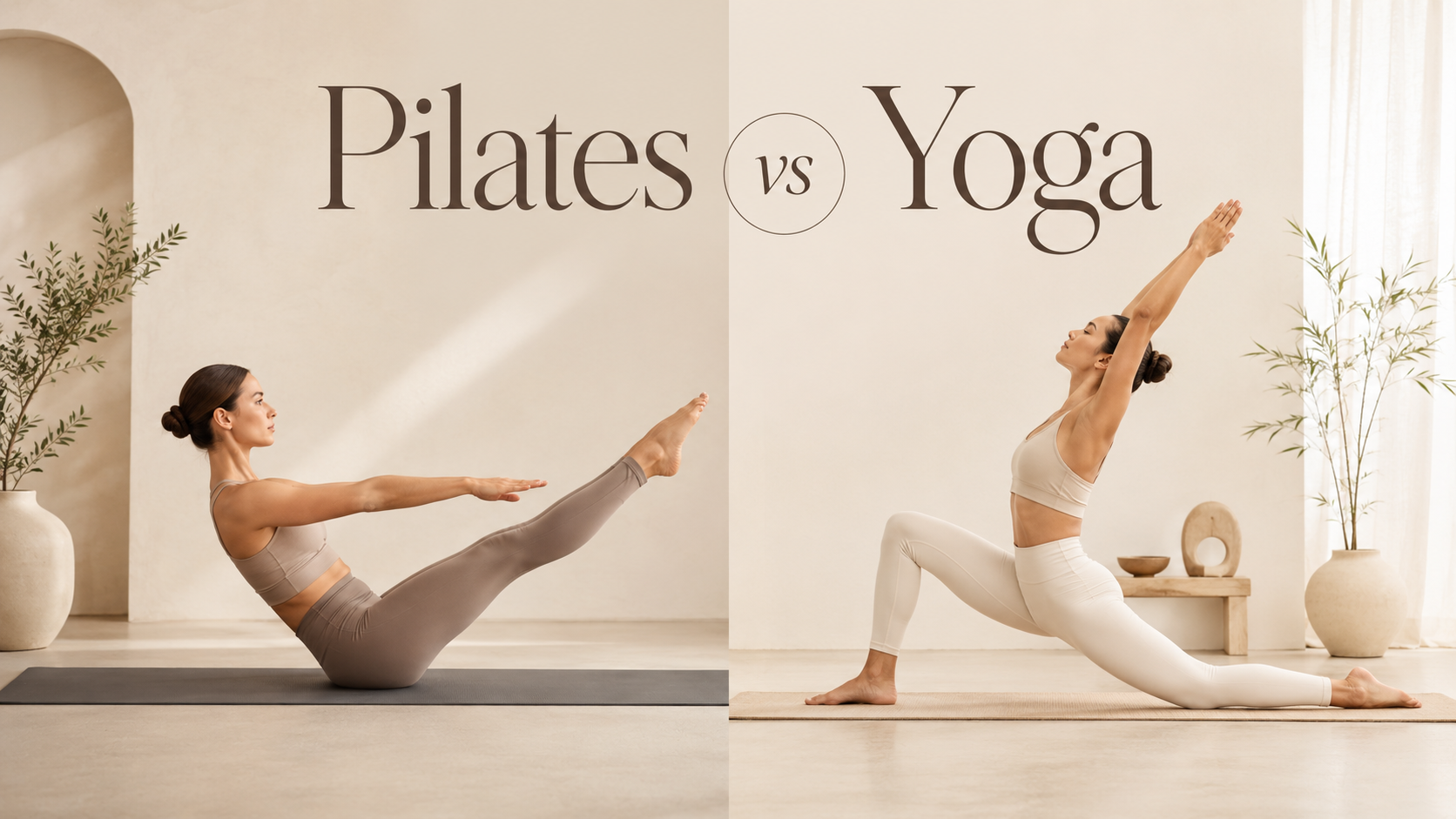
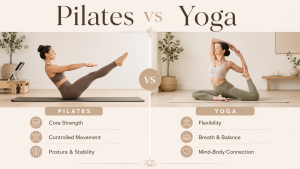
If you’re weighing pilates vs yoga, the short answer is this: both are low-impact practices that improve strength and balance, but pilates focuses more on core strength, posture and physical rehabilitation, while yoga places more emphasis on flexibility, mindfulness and, for many people, a spiritual dimension.
For anyone in Kuala Lumpur — or a similar urban setting with plenty of studio options — trying to decide where to start, that difference matters more than it first appears. From the outside, they can look almost identical: a calm studio, a mat, soft lighting, and people moving with purpose.
But choosing the wrong one for your fitness, recovery or mental wellbeing goals can leave you frustrated, bored, or simply underwhelmed even if the class itself is excellent.
What follows breaks down what pilates and yoga are, where they come from, how they differ, which benefits each one is better suited to — from core strength and injury recovery to stress relief, flexibility and weight loss — plus what beginners should know before booking a class. By the end, you’ll know which one to try first and why.
What is pilates, exactly?
Pilates was developed in the 1920s by a German-born anatomist named Joseph Pilates, originally as a rehabilitation method for injured soldiers returning from World War I. His system was built around one central idea: that almost all movement originates from a strong, stable core — what he called the powerhouse, encompassing the deep abdominal muscles, lower back, hips, and glutes.
The practice spread rapidly through the dance and athletics world, where performers used it to recover from injuries and build functional strength without bulk. Today, pilates is practised in two main formats:
- Mat pilates — exercises performed on the floor using only bodyweight. Accessible, equipment-free, and focused on core control and stability.
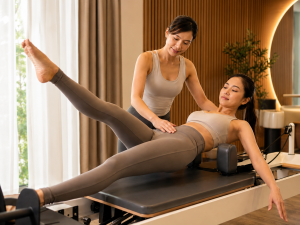
- Reformer pilates — exercises performed on a specially designed machine that uses spring-based resistance. More dynamic, more challenging, and capable of targeting muscles that mat work simply can’t reach.
At LA Pilates Studio KL, we offer both — a mat group class for those building their foundation, and a reformer machine group class for a full-body, resistance-based workout. Both formats share the same core philosophy: precision, control, and intentional movement.
The mental benefits of pilates are real — many members describe it as meditative — but they come as a byproduct of focused physical practice, not from a spiritual tradition. Pilates is, fundamentally, an exercise system.
What is yoga, exactly?
Yoga is a 5,000-year-old discipline rooted in ancient India and its philosophical traditions. It is, at its core, a holistic practice and spiritual practice — physical exercise is just one of its eight limbs. The word “yoga” itself means union: the joining of mind, body, and breath.
Modern studio yoga has evolved significantly from its traditional roots, but even in a contemporary Hatha or Vinyasa class, yoga blends physical poses, breathing techniques, and mindfulness in ways that distinguish it from purely physical exercise. In many classes, deep breathing follows a diaphragmatic belly pattern, usually inhaled and exhaled through the nose.
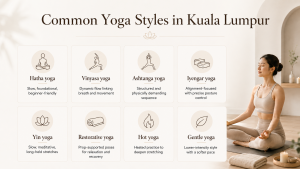
The most common styles you’ll find in KL include:
- Hatha yoga — slow, foundational, and ideal for beginners. Focuses on holding poses and basic breathwork.
- Vinyasa yoga — dynamic and flowing, linking breath to movement. More cardiovascular than Hatha.
- Ashtanga yoga — a structured, demanding sequence practised in a fixed order. Suits disciplined practitioners.
- Iyengar yoga — precision-based, with strong attention to alignment and controlled holds.
- Yin yoga — slow and meditative, holding poses for several minutes to stretch connective tissues.
- Restorative yoga — uses props to support longer-held poses for relaxation and recovery.
- Hot yoga — Vinyasa or Bikram sequences practiced in a heated room, designed to deepen stretching and promote detoxification.
- Gentle yoga — a lower-intensity option suited to those wanting a softer pace.
Yoga is an excellent physical practice. It builds genuine strength, particularly in the upper body and legs. But yoga focuses on flexibility, awareness, and breath through physical postures, which is why the benefits of yoga extend beyond stretching alone.
Pilates vs yoga: the key differences at a glance
| Pilates | Yoga | |
| Origin | Germany, 1920s | India, 5,000+ years ago |
| Primary focus | Pilates focuses on core control and muscle toning | Yoga focuses on flexibility, balance, and mindfulness |
| Philosophy | Movement science | Holistic spiritual practice |
| Equipment | Mat or reformer machine | Mat only (usually) |
| Breathing | Lateral breathing | Diaphragmatic or pranayama-based breathing |
| Spiritual element | Minimal | Central to traditional yoga |
| Best for | Core, rehab, improve posture, sculpting | Stress, flexibility, mental health |
| Intensity | Low to moderate | Low to high (depends on type) |
It’s worth noting that in modern studio settings, the lines between these two practices have softened. Many yoga classes include pilates-inspired core work. Many pilates instructors cue breathwork and mindfulness throughout a session.
If you walk into a well-taught class of either discipline, you may find them feeling more similar than the descriptions above suggest.
But the intent remains different. Pilates is engineered for physical rehabilitation, strength, alignment, and muscle toning.
Yoga is a philosophy that includes physical practice as one of its expressions. That foundational difference matters when you’re choosing which one fits where you are right now.
The benefits of each — broken down by what you actually want
Rather than listing benefits in two separate columns, let’s answer the question the way most people actually ask it: I want X. Which one gives me that?
If your goal is core strength and better posture
Pilates is the clear choice.
If your goal is stress relief and mental clarity
Yoga has the edge.
The breath-led, present-moment nature of yoga practice — especially in slower styles like Hatha or Yin, which is often taught as a gentle yoga option — is one of the most effective non-pharmaceutical tools for nervous system regulation, stress relief, mental clarity and mental health support.
Research consistently links regular yoga practice to reduced cortisol levels, improved sleep quality, and lower reported anxiety, all among the benefits of yoga, especially for people trying to reduce stress.
This isn’t just anecdotal. The deliberate slowing of breath in yoga, including deep breathing, activates the parasympathetic nervous system — your body’s rest-and-digest mode — in ways that a typical workout, including pilates, doesn’t prioritize. If stress is your primary concern, a yoga mat is where you want to start.
If your goal is flexibility
Both help, but yoga builds it faster.
Yoga exercises and static holds are specifically designed to improve flexibility across broad muscle groups, with clear physical benefits beyond general range of motion. With consistent practice, most people see meaningful flexibility gains within four to six weeks.
Pilates improves what’s called functional flexibility — the range of motion you can actually control and use during movement. You won’t necessarily touch your toes faster, but your body will move more freely and with less restriction. For many people — especially those returning from injury — this functional flexibility is more valuable in daily life.
If your goal is injury recovery or prevention
Pilates was literally invented for this.
Joseph Pilates designed his system specifically to rehabilitate injured bodies. It is low-impact, highly adaptable, and can be scaled down or modified for almost any limitation. Reformer pilates is particularly effective for rehabilitation because the spring resistance can be adjusted to support rather than challenge the body — making controlled movement and physical movement possible even during recovery.
If you’re dealing with lower back pain, recovering from a sports injury, or managing a chronic condition like scoliosis, pilates is the more clinically established choice. Many physiotherapists in Malaysia integrate pilates principles directly into their rehabilitation programmes, especially to support certain health conditions and help manage chronic pain.
If your goal is weight loss
Neither is a primary fat-burning tool — but both contribute.
Pilates builds lean muscle, which raises your resting metabolic rate over time. A reformer pilates session typically burns 250–450 calories, depending on intensity and individual factors. Yoga burns less — usually 200–350 calories for a moderate class — though a vigorous Vinyasa session can push that higher.
The more meaningful weight management benefit from both practices is often indirect. Pilates helps build the body composition that supports a healthy metabolism. Yoga, by reducing cortisol and stress, addresses one of the most underestimated contributors to weight gain in modern urban life. Both complement, rather than replace, cardio or strength training for weight loss goals.
If you’re a complete beginner
You’re genuinely welcome in both.
Neither pilates nor yoga requires any prior experience, and both can fit easily into a beginner fitness routine regardless of fitness level or flexibility. Both practices are taught progressively, and a good instructor will offer modifications for every ability level.
The more useful question for a beginner isn’t “which one accepts beginners” — it’s “which experience do I want to have?” Pilates offers structure: clear technique, measurable progression, and a sense of physical accomplishment after each session. Yoga offers immersion: breath, awareness, and a practice that follows you off the mat and into the rest of your day, so yoga and pilates can create different beginner experiences.
So — which one should you actually start with?
Here’s a simple self-assessment. Read through each list and see which one you’re nodding along to.
Start with pilates if:
- You have lower back pain, a desk job, or noticeably poor posture
- You want a structured workout with clear technique, better body alignment, and tangible progress
- You’re recovering from an injury or want to prevent one
- You want to build strength and tone without high-impact exercise
- You’re curious about reformer machines and resistance-based training
Start with yoga if:
- Stress, anxiety, or poor sleep is your biggest daily challenge
- You want deep, full-body flexibility and a slower, more meditative pace
- You’re interested in movement as a philosophical tradition or spiritual practice
- You prefer flowing, intuitive movement over counted repetitions
The honest answer for most people in KL? Try both.
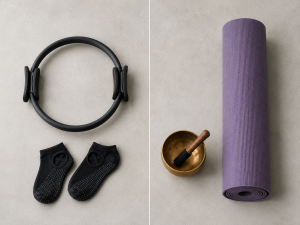
Many members at LA Pilates Studio combine reformer or mat pilates with yoga sessions in the same week — and for good reason. The two practices are genuinely complementary. Pilates builds the core strength and body awareness that makes challenging yoga poses accessible. Yoga develops breath control, flexibility, and comfort with yoga poses that improves pilates form and recovery. Together, yoga and pilates support physical benefits as well as mental health in ways that neither reaches alone.
Ready to try? Here’s what to expect at LA Pilates Studio KL
LA Pilates Studio is based in Kuala Lumpur, and we welcome members at every level — from those who have never set foot on a reformer to practitioners looking to deepen an existing practice.
Our classes include:
- Reformer Machine Group Class — a full-body reformer class using our specialized reformer machines. Spring-based resistance builds long, lean muscles and core strength. Suitable for all fitness levels.
- Mat Group Class — pilates fundamentals in guided mat classes using bodyweight. A strong foundation class that builds core stability, flexibility, and body awareness.
- Private Class — one-on-one sessions tailored entirely to your goals, whether that’s injury rehabilitation, technique refinement, or a personalized progression plan.
No experience is needed for any of our classes. Our instructors guide you through every movement, and our pilates workouts are instructor-led and adaptable — so whether it’s your first time on a reformer or your fiftieth, you’ll always have expert support for different goals and experience levels.
The bottom line
Pilates and yoga are both exceptional practices. They share more than most people realize — low impact, mindful movement, and numerous health benefits with real physical benefits — but they serve different primary goals.
Pilates is for you if strength, posture, core stability, and structured progression are what you’re after. Yoga is for you if flexibility, stress relief, and a holistic mind-body practice are your priorities.
And if you’re still not sure? The most honest answer is to show up and try. One class will tell you more than a hundred articles.
Whether you’re drawn to the reformer machine or the yoga mat, LA Pilates Studio KL has a class for you. Browse our full schedule and book your first class.
Frequently Asked Questions
1. Is pilates or yoga better for beginners?
Both are suitable for complete beginners. Pilates offers more structured technique guidance, which many newcomers find easier to follow. Yoga varies widely in intensity depending on the style — a Hatha class is very gentle, while Vinyasa can be fast-paced. The best choice depends on whether you want a workout-first or mindfulness-first experience.
2. Can I do both pilates and yoga?
Absolutely. Many members find that yoga and pilates work well together in the same week. Both offer health benefits and complement each other well — pilates builds the strength and stability that makes yoga poses more accessible, while yoga improves the flexibility and breath awareness that enhances pilates form. Both are low-impact, so there’s no overtraining risk from doing both.
3. Is reformer pilates the same as mat pilates?
No. Mat pilates uses only your body weight, while reformer pilates uses a machine with adjustable spring resistance, and classical pilates includes both mat work and apparatus-based training. The reformer allows for a greater range of motion and can target muscles that mat work can’t reach as effectively. Both build core strength, but reformer pilates is more dynamic and versatile.
4. Which burns more calories — pilates or yoga?
Reformer pilates generally burns more calories than yoga due to the resistance and muscle engagement involved. A typical reformer session burns approximately 250–450 calories, while a moderate yoga class burns 200–350. That said, neither is primarily a calorie-burning workout — both are better understood as tools for body composition, mobility, and long-term physical wellbeing.