If your back aches by 3pm every workday, you’re not alone. Long hours at the desk, the daily crawl through KL traffic, evenings hunched over your phone. It adds up, and your back is usually the first to complain.
Maybe you’ve also been told you have scoliosis. Or you’ve just finished physio for an injury and you’re not quite sure what to do next.
Somewhere along the way, someone probably said, “You should try Pilates.”
The short answer: yes, Pilates can help everyday back pain and ease the stiffness that comes with scoliosis. It’s also a great way to rebuild strength after an injury. It can’t straighten a scoliosis curve, though, and when you’re in pain, a private session is the safest way to start.
But there’s a catch: how you start matters a lot more than people think. Jump into a busy group class while your back is sore, and it’s easy to do too much, too soon.
So let’s talk honestly about what Pilates can do for your back, what it can’t, and why we at LA Pilates Studio KL almost always suggest starting with private sessions.
A quick note before we start: we’re Pilates instructors, not doctors. This article is here to help you understand your options, not to diagnose anything. If your pain is severe, getting worse, or comes with numbness or weakness, please see a doctor or physio first. There’s a list of warning signs further down.
So, does Pilates actually help back pain?
For most people with everyday back pain, the kind with no clear injury behind it, the short answer is yes.
And it’s not just us saying that. A large Cochrane review (one of the most trusted types of research summary out there) looked at 10 studies with 510 people who had lower back pain. It found that Pilates probably helps reduce pain and makes daily life easier, compared with doing very little (Yamato et al., 2015).
Here’s the honest part, though. The same review found that Pilates isn’t clearly better than other kinds of exercise. It’s not a magic cure.
What it is, is a really good way to exercise when your back is sensitive. It’s gentle on your joints, it’s slow and controlled, and every move can be made easier or harder. That makes it something people actually stick with. And with back pain, sticking with it is what counts.
Here’s what Pilates works on:
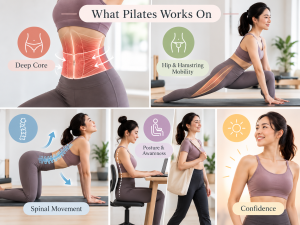
- Your deep core. Not six-pack muscles, but the deep ones that wrap around your spine and pelvis like a natural support belt.
- Tight hips and hamstrings. When these get tight from sitting all day, they tug on your lower back.
- Getting your spine moving again. When your back hurts, you naturally start moving it less. Pilates helps bring that movement back, gently.
- Posture and awareness. You start noticing how you sit at your desk, how you pick up your bag, how you stand in the MRT.
- Confidence. This one’s underrated. A lot of people with back pain are scared to move. Feeling strong and safe again is a big part of getting better.
When Pilates is a good fit
- Your back feels stiff or achy, and it keeps coming back
- It gets worse after long hours of sitting or driving
- Physio helped, but the pain creeps back once you stop your exercises
- Your back feels weak more than it feels injured
When to see a doctor first
- You’ve just hurt your back, especially from a fall or accident
- Pain shoots down your leg with numbness, tingling or weakness
- The pain is severe or getting worse fast
- You have any of the warning signs listed later in this article
Pilates for scoliosis: what it can (and can’t) do
Scoliosis means your spine curves sideways, often with a bit of a twist. If you have a mild curve, you probably know the feeling: one side of your back always feels tighter, one shoulder sits a little higher, and aches come and go.
Pilates can help you feel a lot better. It can:
- Ease the tightness and aches
- Build strength evenly on both sides, so one side isn’t doing all the work
- Help you notice how you stand and move
- Use breathing to open up the tighter, squashed side of your rib cage
- Make everyday movement feel easier
What it can’t do is straighten your spine. We want to be really upfront about that. If anyone promises Pilates will “fix” or “correct” your curve, be careful.
There is good news on the research side, too. In 2024, a team from Universiti Putra Malaysia reviewed nine studies on Pilates for spinal curves and posture. They found it helped with posture, pain, daily function and quality of life. They also noted the studies were small, so there’s more to learn. But it’s encouraging, and nice to see this research coming from right here in Malaysia.
Is there Pilates made specifically for scoliosis?
Yes. The best known scoliosis exercise approach is the Schroth method, which is usually taught by physiotherapists. There are also Pilates-based programmes like Scolio-Pilates®, and scoliosis training for Pilates instructors is taught here in KL.
Please see a specialist (an orthopaedic doctor, or a physio trained in scoliosis exercise) if:
- You’re a teenager who’s still growing, or you’re the parent of one
- Your curve seems to be getting worse
- You’ve got a bigger curve, or you’ve been told about bracing or surgery
If you’re an adult with a mild, stable curve and you just want to feel less stiff and more even, private Pilates can be a great fit. You can do it on its own or alongside physio.
What we usually go easy on
With scoliosis, we tend to hold back on heavy twisting, lots of deep forward bending with load, and forcing the same stretch on both sides. Your body isn’t symmetrical, so your workout shouldn’t pretend it is. A good instructor works with your curve instead of trying to squeeze you into the “standard” version of an exercise.
Where Pilates fits when you’re recovering from an injury
Here’s something we see all the time. Someone finishes physio, their physio says they’re good to go, and they jump straight back into a busy class or the gym. A few weeks later, the same problem came back.
Recovery usually has four stages, and that third one gets skipped a lot:
- Find out what’s wrong. See a doctor or specialist to get a diagnosis and rule out anything serious.
- Early rehab. A physiotherapist helps settle the pain and gets you moving again.
- Rebuild your strength. Once you’re cleared, you slowly rebuild strength, control and confidence with someone watching closely. This is where private Pilates fits in.
- Keep it going. Group classes help you stay strong and stop the problem from coming back.
Think of private Pilates as the bridge between “my physio says I’m fine” and “I can safely join a normal class.” We often see people coming back from lower back pain, knee or shoulder problems, or just a long break from exercise.
The same goes if you’re pregnant or have just had a baby. Start with sessions made for your stage. Have a look at our pre- and post-natal private sessions.
Why private sessions work better when you’re in pain
Group classes are great. We love them. But when your back hurts, they have some limits.
Your instructor is watching eight or ten people at once. Everyone follows the same plan. And if you’re like most of us, you’ll push a bit harder than you should just to keep up with the person next to you.
A private session is different:
- We check you first. Before any exercise, your instructor looks at how you move, how you stand, and what’s been going on. Then we decide where to start.
- Every exercise is picked for you. Nothing’s in there just because “it’s part of the class.”
- We can make things lighter. On the reformer, the springs can support you, so an exercise that would be too much on the mat becomes doable. We can also keep your movements small until your body’s ready for more.
- Mistakes get fixed straight away. Things like arching your lower back or holding your breath are easy to miss in a class. In a private session, we catch them at the moment.
- Bad week? No problem. If your back’s grumpy that day, we change the plan. If you’re feeling great, we move you forward.
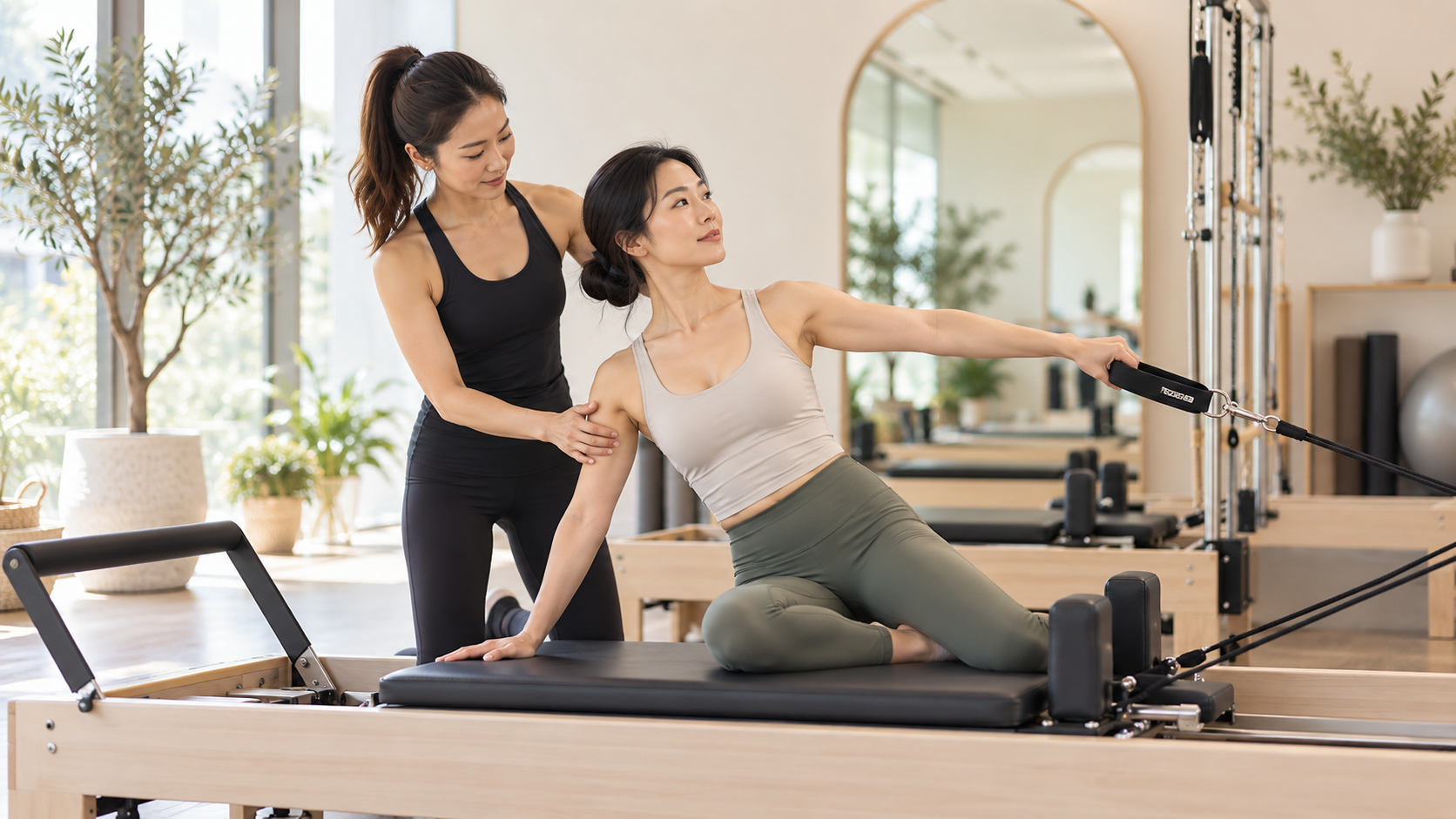
- You get the special equipment. The Cadillac lets us support gentle spine and hip work. The barrel is brilliant for supported back-bends and side-bends, which is really useful for scoliosis. We also use the reformer and chair.
Put simply, a group class asks your body to fit the class. A private session builds the class around your body.
“Clinical Pilates” vs private Pilates: what’s the difference?
If you’ve been Googling Pilates for back pain in KL, you’ve probably seen “clinical Pilates” everywhere. Here’s the simple version:
- Clinical Pilates is usually run by a physiotherapist. It’s part of a treatment plan, and they can diagnose and treat your condition.
- Private Pilates at a studio like ours is run by a certified Pilates instructor. It’s exercise, done within the advice your doctor or physio has given you.
So which one do you need? If you don’t know what’s causing your pain yet, or you’ve only just been injured, see a physio first. Honestly, that’s the right call. Once you’ve been checked and cleared to exercise, private Pilates is a great next step. It can also run alongside your physio sessions.
What your first private session looks like
A lot of people feel a bit nervous before their first session, especially if they’re in pain. Here’s what actually happens:
- We chat. We’ll ask about your pain, any injuries, your medical history and what you want to get out of this.
- We look at how you move. Your instructor checks your posture, how you breathe and how your core is working.
- We start with the basics. You’ll learn how to breathe properly and switch on your deep core. It sounds simple, but everything else builds on it.
- We try some gentle exercises on the mat or equipment, whatever suits your body that day.
- We made a plan. You’ll leave knowing what the next few sessions will focus on, and usually with one or two easy things to try at home.
Handy to bring along:
- Any notes from your doctor or physio
- If you have scoliosis, your X-ray report or Cobb angle measurement, if you have one
- Comfortable, fitted clothes, and grip socks if you’re using the machines
You can read more about our pilates private class options here.
Gentle moves you’ll probably meet early on
Here are a few of the first exercises we often use with people who have back pain. We’re sharing them so you know what to expect, not as a DIY home programme. If anything makes your pain sharper or it starts spreading, stop, and check with your doctor or physio.
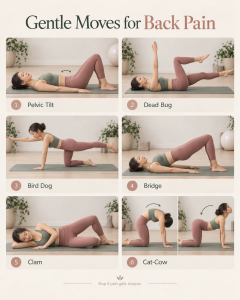
- Pelvic tilt. Lie on your back with knees bent and gently press your lower back into the mat, then let it go. It’s small, but it teaches you to control your pelvis.
- Dead bug. Lie on your back with arms up and knees bent. Slowly lower one leg while keeping your back still. Harder than it looks!
- Bird dog. On hands and knees, reach one arm forward and the opposite leg back without letting your back wobble.
- Bridge. Lie on your back and peel your spine off the mat one bit at a time, then roll back down. Lovely for a stiff back.
- Clam. Lie on your side with knees bent and open your top knee like a clamshell. It wakes up the hip muscles that support your pelvis.
- Cat-cow. On hands and knees, round your back up, then let it gently dip. A nice way to get a stiff spine moving.
You might have also heard of the “big 3” for lower back pain: the curl-up, side plank and bird dog. They’re popular because they build core strength without putting much strain on your spine. Pilates works on a lot of the same ideas.
What to avoid when your back is flaring up
When your back’s having a bad patch, we usually hold off on or change these:
- Deep forward bends with load, like the rollover, teaser or jackknife
- Fast or heavy twisting
- High-impact stuff like jumpboard or HIIT-style Pilates
- Forcing a stretch because you feel it “should” go further
- Pushing through pain just to finish a set
Don’t worry, this isn’t forever. Lots of these come back later once you’re stronger. It’s all about building up step by step.
Warning signs: please see a doctor first
Get checked by a doctor before starting any exercise if you have any of these. The first two need urgent attention:
- New trouble controlling your bladder or bowels
- Numbness around your buttocks, groin or inner thighs
- Leg weakness that’s getting worse, or new trouble walking
- Back pain after a fall, accident or knock
- Fever, unexplained weight loss, or pain that’s worse at night
- Pain that’s severe or getting worse quickly
How often, and how long until I feel better?
Everyone’s different, but here’s what often works:
- For the first 6 to 8 weeks: 1 to 2 private sessions a week, to learn the basics and build strength safely.
- After that: Group classes 2 to 3 times a week, with a private session now and then to check your form or move you forward.
Some people feel a difference after just a few sessions. For others, especially with long-term pain or scoliosis, it takes a few weeks. Showing up regularly makes a much bigger difference than going hard.
How much does it cost?
Here’s what private sessions cost at LA Pilates Studio KL:
| Mat (mat Pilates, yoga) | Machine (reformer, chair) | |
| Single 1-to-1 session | RM180 | RM200 |
| 3-session starter pack | RM480 | RM540 |
| 10 sessions | RM1,500 | RM1,750 |
Questions people often ask us
1. Is Pilates good for back pain?
For most everyday back pain, yes. Research shows it can reduce pain and make daily life easier. It works about as well as other good exercise, so the real secret is doing it regularly, with the right guidance.
2. Yoga or Pilates: which is better for back pain?
Both can help. Pilates leans more towards core strength and control, while yoga leans more towards flexibility and relaxation. If your back feels weak or wobbly, Pilates is a nice place to start. If it feels tight and tense, yoga might suit you better. Plenty of people do both! Here’s our full take on Pilates vs yoga.
3. Can Pilates straighten my scoliosis?
No, it can’t change the curve itself. But it can ease pain, build even strength, improve your posture and help you move more comfortably. If your curve is getting worse, or you’re a teenager who’s still growing, please see an orthopaedic specialist.
4. Is reformer Pilates safe if I have a bad back?
It can be, and it’s often a good choice. The springs can support you and make exercises lighter. But some reformer exercises do put a lot of load through your spine, so start with private sessions, where your instructor can choose and adjust every move for you.
5. Can I do Pilates with a slipped disc?
Lots of people with a slipped disc do well with carefully guided exercise. Check with your doctor or physio first, though, especially if you have leg pain, numbness or weakness. In the early stages we usually avoid deep forward bends with load, and we’ll work within whatever your doctor has advised.
6. Do I need a doctor’s letter before I start?
If you’ve got a diagnosed condition, a recent injury, you’ve had surgery, or you have any of the warning signs above, yes, please get cleared first. For general stiffness or mild, long-running back pain, you don’t always need one. Just tell your instructor about any pain before you start.
7. Can I just join a group class instead?
If your pain is mild and settled and you already know the basics, a beginner group class might be fine. But if you’re sore right now, have scoliosis or are recovering from an injury, we’d really suggest a few private sessions first. It’s what we recommend to anyone who’s injured or pregnant.
8. Are there any downsides to Pilates?
A few. It won’t do much for your cardio fitness on its own, progress can feel slow at first, and private sessions cost more than a gym membership. Done without guidance, some moves can also irritate a sensitive back. That’s why starting in the right place, with the right instructor, matters so much.
Ready to give your back some proper attention?
If you’re dealing with back pain or scoliosis, or you’re coming back from an injury, you don’t have to figure it out alone. A private session lets us build your workout around your body, not the other way round.
Drop us a WhatsApp at 012-818 8076 and tell us a little about what’s going on. We’ll suggest where to start and pair you with the right instructor.
LA Pilates Studio KL, 28-2, Level 2, ECO SKY 972, Batu 6½, Jalan Ipoh, Taman Wahyu, 68100 Kuala Lumpur. Plenty of covered parking, and a short drive from Kepong, Selayang, Segambut and Sentul.