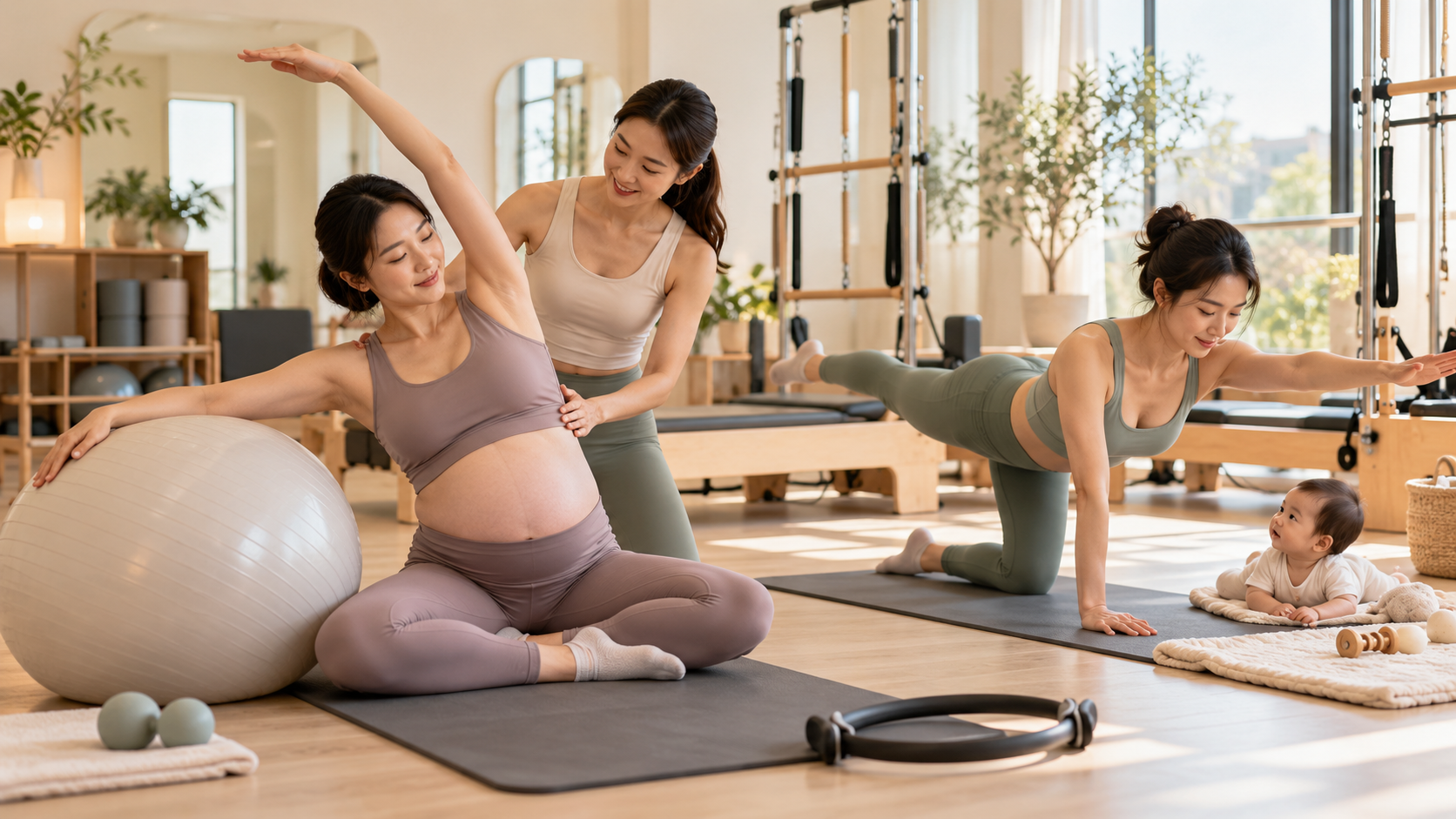
Pregnancy changes your body quickly.
One month you may feel almost like yourself. A few weeks later, getting out of bed, walking up the stairs or finding a comfortable sleeping position can suddenly feel very different.
After your baby arrives, things change again.
Your abdominal muscles, pelvic floor, posture and energy levels have all been through a lot, and getting back into exercise is not something you need to rush.
This is why many mums searching for prenatal Pilates in KL or postnatal Pilates in KL are not necessarily looking for a tough workout. Most simply want to know:
Can I still exercise safely, and what kind of movement is right for me now?
Pilates can be a useful option during pregnancy and after birth because exercises can be modified as your body changes. But prenatal and postnatal Pilates should never be treated exactly like a normal Pilates class.
Here is what to know before you start.
Is Pilates Safe During Pregnancy?
For most people with a healthy, uncomplicated pregnancy, staying physically active is generally encouraged.
The American College of Obstetricians and Gynecologists (ACOG) specifically lists modified Pilates among the activities that can be suitable during pregnancy. The important word here is modified. Your normal Pilates routine may need to change as your pregnancy progresses.
Pregnancy affects your balance, breathing, joints, abdominal wall and the way your body handles physical effort.
So prenatal Pilates is not about trying to maintain exactly the same exercises or intensity you used before pregnancy.
A good programme adapts with you.
You should also tell your doctor that you plan to exercise during pregnancy, particularly if you are starting something new or have any medical or pregnancy-related concerns.
What Is Prenatal Pilates?
Prenatal Pilates takes familiar Pilates principles such as controlled movement, breathing, posture and strength and adapts them for pregnancy.
Rather than concentrating on pushing yourself harder, the focus is usually on keeping you moving comfortably while helping your body manage the physical changes taking place.
Your session might work on:
- Deep core and pelvic floor coordination
- Hip and glute strength
- Upper-back and shoulder strength
- Comfortable hip and spinal mobility
- Balance and stability
- Breathing
- Posture
- General strength for everyday movement
These things become surprisingly practical during pregnancy.
Stronger legs and hips can help when getting up from chairs. Upper-body strength becomes useful when carrying everything from shopping bags to, eventually, a baby. Better body awareness can also help you adjust the way you stand, sit and move as your centre of gravity changes.
Can Beginners Start Pilates While Pregnant?
Being pregnant does not automatically mean you need previous Pilates experience.
However, starting with personalised instruction can make things much easier if Pilates is completely new to you.
Your instructor can show you how the equipment works, explain breathing and alignment, and make sure you are not trying to copy exercises designed for someone who is not pregnant.
Several Pilates studios in Kuala Lumpur take a similar approach, with some recommending private or specialised prenatal sessions so exercises can be adapted individually.
At LA Pilates, clients who are pregnant are encouraged to begin with a private class, allowing the instructor to provide individual attention and modifications.
How Does Pilates Change as Your Pregnancy Progresses?
There is no single prenatal Pilates routine that works from the beginning of pregnancy until delivery.
Your needs can change throughout each trimester.
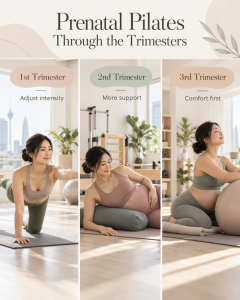
First Trimester
For some women, very little looks different physically yet.
But fatigue, nausea and changes in energy can make exercise feel completely different.
If your doctor is comfortable with you exercising, sessions may still include many familiar movements, but intensity can be adjusted depending on how you feel that day.
This is not usually the time to chase personal bests.
Some days, simply moving comfortably is enough.
Second Trimester
As your bump grows, exercises often need more obvious modification.
Your centre of gravity is changing, balance can feel different, and spending long periods lying flat on your back is generally avoided later in pregnancy.
Exercises may therefore move into side-lying, seated, kneeling or supported positions.
ACOG and NHS pregnancy guidance both recommend modifying exercises that involve prolonged flat-on-the-back positions as pregnancy progresses.
Third Trimester
By the third trimester, comfort usually becomes an even bigger priority.
Your range of motion may naturally become smaller and getting on and off equipment may take more care.
Sessions can focus on controlled strength, breathing, mobility and movements that feel useful rather than complicated.
Some days you may feel energetic.
Other days you may need to slow things down.
A good prenatal Pilates session allows for both.
What About Reformer Pilates During Pregnancy?
You do not necessarily have to give up the Reformer because you are pregnant.
In fact, the springs and adjustable setup can provide both resistance and support.
The important part is choosing suitable exercises and positions.
You may notice your instructor changing the spring resistance, adding props, adjusting your range of movement or replacing exercises entirely as your pregnancy progresses.
The goal is not to prove that you can still perform the same Reformer routine you did before pregnancy.
The goal is to keep moving in a way that makes sense for your body now.
Exercises You May See Modified During Prenatal Pilates
You might notice that certain movements look quite different from a standard Pilates class.
For example:
Abdominal exercises may move away from intense curling and towards breathing, control and whole-core coordination.
Exercises lying flat on your back may be shortened, elevated or replaced later in pregnancy.
Balance exercises may include more support.
Deep stretches may be approached more carefully rather than trying to reach your maximum range.
High-intensity movements may be reduced when they no longer feel appropriate.
Your instructor may also adjust things simply because something feels uncomfortable.
That is normal.
Pregnancy Pilates is supposed to adapt to you—not the other way around.
When Should You Stop Exercising During Pregnancy?
Listening to your body matters, but there are also symptoms that should not simply be pushed through.
ACOG advises stopping exercise and contacting your healthcare provider if you experience warning signs such as vaginal bleeding, dizziness, chest pain, painful regular contractions, fluid leakage, significant shortness of breath before exercising, or calf pain or swelling.
You should also follow any exercise restrictions given by your doctor or maternity care team.
Your Pilates instructor can modify exercises.
They cannot diagnose pregnancy complications.
What Happens After the Baby Arrives?
Postnatal Pilates is a different stage entirely.
After months of adapting to pregnancy and then giving birth, it can be tempting to think:
“I just need to strengthen my core again.”
But postnatal recovery involves much more than doing abdominal exercises.
Your pelvic floor, abdominal wall, back, hips and overall strength may all need time to recover.
You are also suddenly spending a lot of time feeding, carrying and lifting your baby—often while running on much less sleep.
So the goal of postnatal Pilates should not simply be getting your old body back.
A better goal is helping your body cope comfortably with your new daily life.
When Can I Start Postnatal Pilates?
There is no perfect week that applies to everyone.
After an uncomplicated vaginal birth, gentle activity such as walking, stretching and pelvic floor exercises may be possible quite early if you feel comfortable.
After a C-section, complicated delivery or other medical concerns, recovery may take longer.
NHS guidance recommends getting individual advice before returning to strenuous exercise following a complicated delivery or caesarean, while ACOG recommends resuming exercise gradually once it is medically safe based on the type of delivery and any complications.
That is why your postnatal check matters.
Instead of thinking:
“Everyone starts Pilates at six weeks.”
Think:
“When is my body ready to start, and what should I start with?”
Those are two very different questions.
What Does Postnatal Pilates Work On?
Your first postnatal Pilates sessions may look much gentler than the workouts you remember.
That does not mean they are doing nothing.
Early sessions may focus on rebuilding the connection between your breathing, pelvic floor and abdominal muscles before adding more demanding movement.
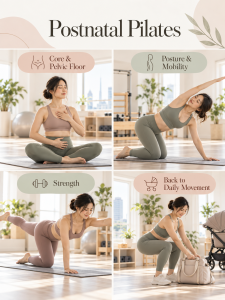
You might work on:
- Breathing and deep core control
- Pelvic floor coordination
- Hip and glute strength
- Back and shoulder strength
- Posture
- Mobility
- Balance
- Gradually returning to full-body exercise
There is also a very practical side to this.
Carrying your baby, lifting a stroller, feeding for long periods and repeatedly getting up from the floor all place demands on your body.
Postnatal Pilates can gradually prepare you for those movements too.
What About Diastasis Recti?
Diastasis recti—the separation between the abdominal muscles—is common during and after pregnancy.
If you notice a gap, bulging or doming around the middle of your abdomen, it can be tempting to panic or avoid using your core completely.
But recovery should not be judged only by how many fingers fit into a gap.
What matters is also how well your abdominal wall manages pressure and movement.
Postnatal exercise may help rebuild abdominal strength and function, but no responsible instructor should promise that Pilates will completely “close the gap” for everyone.
If you have significant doming, pain or concerns about your abdominal recovery, it is worth speaking to a women’s health or pelvic-floor physiotherapist for an individual assessment.
What About Your Pelvic Floor?
Your pelvic floor works together with your breathing, abdominal muscles and the rest of your body.
Pregnancy and childbirth can place a lot of demand on it.
You may notice symptoms such as leaking urine, heaviness or pressure.
These symptoms should not simply be accepted as something every mum has to live with.
Pelvic-floor exercises are commonly recommended during and after pregnancy, but symptoms that persist or interfere with exercise deserve proper assessment.
And more Kegels are not automatically the answer for everyone.
Sometimes the issue is strength.
Sometimes it is coordination.
Sometimes the muscles may not be relaxing properly.
That is another reason individual assessment matters.
Is Postnatal Pilates Safe After a C-Section?
Pilates may eventually form part of your return to exercise after a C-section, but it is important to remember that a caesarean is abdominal surgery.
Healing comes first.
Your doctor should guide you on when structured exercise is appropriate based on how your wound is healing and whether there were any complications.
When you are ready, postnatal Pilates normally begins gradually.
Your first session is unlikely to involve aggressive abdominal exercises.
It may instead focus on breathing, posture, mobility and gentle strength before progressively adding more resistance.
There is no prize for returning faster than somebody else.
Private vs Group Prenatal and Postnatal Pilates
Group Pilates can be enjoyable during pregnancy and after birth when the class is specifically designed for prenatal or postnatal clients and you are comfortable following the programme.
Private Pilates provides a different level of attention.
Your instructor can adjust each exercise depending on:
- Your trimester
- How your pregnancy is progressing
- Your previous Pilates experience
- How you delivered your baby
- How far postpartum you are
- Your current comfort and energy level
- Any instructions from your doctor or physiotherapist
That can be especially reassuring when this is your first pregnancy, your first time trying Pilates, or you are returning to exercise after giving birth.
LA Pilates offers private pre-natal and post-natal Pilates in both 1-to-1 and 2-to-1 formats, allowing sessions to be tailored around each client’s needs.
What to Expect From Your First Private Prenatal or Postnatal Pilates Session
You do not need to arrive knowing Pilates terminology or how to use a Reformer.
Your instructor should first understand where you are.
For a prenatal client, that may include discussing your trimester, previous exercise experience, how you are feeling and any guidance from your doctor.
For a postnatal client, relevant information may include how long it has been since delivery, whether you had a vaginal or caesarean birth, any discomfort you are experiencing and whether you have been cleared to exercise.
From there, the session can be adjusted.
You may work with Pilates equipment or begin with simpler movements depending on what suits you.
Do not be surprised if your first class feels more controlled than intense.
The instructor is learning how you move too.
Do You Need to Be Fit Before Starting?
No.
You also do not need to “get your core back” before attending postnatal Pilates.
That would be like saying you need to become flexible before going to a stretching class.
You start from where you are.
If you exercised regularly before pregnancy, your programme may progress differently from someone completely new to movement.
Neither starting point is wrong.
How Hard Should Prenatal Pilates Feel?
Moderate exercise during an uncomplicated pregnancy should generally still allow you to speak while moving.
The NHS uses the simple “talk test”: if you become so breathless that you cannot comfortably hold a conversation, you may be working too hard.
That is particularly useful in Kuala Lumpur, where heat and humidity can add another layer of stress when exercising before or after travelling to the studio.
Stay hydrated and tell your instructor if you feel unusually tired, dizzy or uncomfortable.
Choosing a Prenatal or Postnatal Pilates Class in KL
There are now plenty of Pilates studios across Kuala Lumpur.
When you are pregnant or newly postpartum, though, class choice matters more than finding whichever slot happens to fit your schedule.
Before booking, ask:
- Does the instructor have experience with prenatal or postnatal clients?
- Is the class specifically adapted for pregnancy or postpartum recovery?
- Can exercises be modified individually?
- Would a private session be more suitable for me?
- What information should I provide before my first class?
- Should I obtain clearance from my doctor first?
A studio should be comfortable answering these questions.
If the response is simply “you’ll be fine,” that probably is not enough information.
Prenatal & Postnatal Pilates at LA Pilates KL
LA Pilates offers personalised prenatal and postnatal sessions for mothers who would like more individual guidance before and after birth.
Private sessions are available in 1-to-1 and 2-to-1 formats, so the workout can be adapted around your stage, goals and movement needs rather than expecting you to follow a standard group routine.
You can also check the private prenatal and postnatal Pilates pricing before booking to find the session format that best suits your needs.
LA Pilates is located at ECO SKY, Jalan Ipoh, Taman Wahyu, Kuala Lumpur, making it convenient for clients coming from surrounding areas of northern KL and nearby Selangor.
Whether you are trying to stay comfortably active during pregnancy or slowly rebuild strength after birth, the starting point is the same:
Meet your body where it is today.
Not where it was six months ago.
And not where somebody else’s body is.
Questions mums often ask us
1. Is Pilates safe during pregnancy?
For most healthy women with uncomplicated pregnancies, modified Pilates can be an appropriate form of exercise. Your routine should be adapted as pregnancy progresses, and you should discuss exercise with your doctor, particularly if you have any pregnancy complications.
2. When can I start prenatal Pilates?
There is no single starting week that applies to every pregnancy. Some KL studios begin dedicated prenatal programmes from the second trimester, but medical suitability and your individual circumstances matter more than the calendar.
3. Can I do Reformer Pilates while pregnant?
Reformer Pilates can be adapted during pregnancy. Resistance, body position and exercises may need to change as your pregnancy progresses. If you are new to Reformer Pilates, private prenatal instruction can provide more individual guidance.
4. Can I start Pilates if I have never exercised before pregnancy?
You may still be able to exercise during an uncomplicated pregnancy, but start gradually rather than suddenly beginning a demanding routine. Let your instructor know that you are a beginner and discuss exercise with your maternity care provider.
5. When can I start Pilates after giving birth?
It depends on your delivery and recovery. Gentle activity may be possible quite early after an uncomplicated birth, while structured Pilates or more demanding exercise may need to wait. Recovery after a C-section or complicated birth generally requires additional medical guidance.
6. Can Pilates help with diastasis recti?
Postnatal exercise can help rebuild abdominal function and strength, but Pilates should not be marketed as a guaranteed way to completely close abdominal separation. Persistent symptoms or concerns are best assessed by an appropriate healthcare professional.
7. Is private Pilates better during pregnancy?
Not necessarily for everyone, but private Pilates offers more opportunity to adjust exercises to your trimester, comfort and experience. It can be particularly useful for beginners or anyone needing more personalised modifications.
8. Can I do Pilates after a C-section?
Potentially, once your healthcare provider confirms that returning to exercise is appropriate. Progress should be gradual because a C-section involves abdominal surgery and recovery varies from person to person.
Move Through Motherhood at Your Own Pace
Pregnancy and postnatal recovery are not times when you need to compete with your previous fitness level.
Your body is doing something different now.
Prenatal Pilates can help you keep moving, maintain strength and adapt to your changing body. Postnatal Pilates can provide a gradual route back into exercise as you rebuild strength, control and confidence.
The most important part is choosing a movement that suits your stage and your recovery.
If you are looking for prenatal or postnatal Pilates in Kuala Lumpur, LA Pilates offers personalised private sessions where exercises can be adjusted around your individual needs.
Speak with the LA Pilates team about a private prenatal or postnatal session and find a comfortable place to begin.